
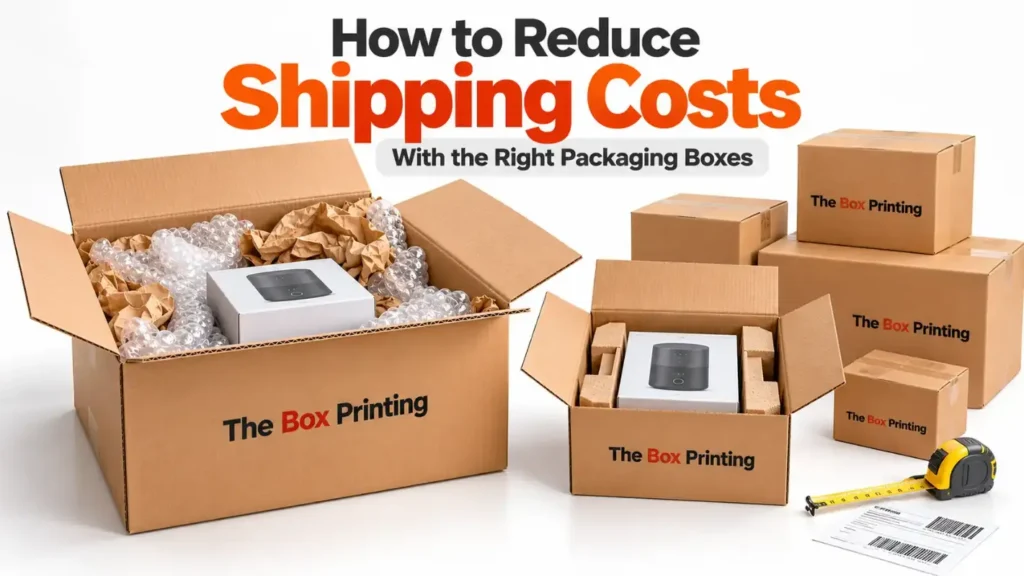
If you ship a lot of orders in the US, you already know shipping is eating your profit. It is not just the carrier rates going up. It is the box itself. A box that is too big, too heavy, or just not right for the product will cost you on every single order. And that adds up fast. Most brands we talk to at The Box Printing are not overpaying because of the carrier – they are overpaying because they are shipping a lot of empty space. The good news is, fixing your packaging is one of the easiest ways to bring those costs down without hurting your delivery experience. That is what right-size packaging is all about.
1. Choose the Right Box Size to Avoid Paying for Empty Space
This is where most money gets wasted. A big box needs more filler. It weighs more. It takes more space in your warehouse, more space on the pallet, and more space in the delivery truck. And carriers charge you for all of it. If your product rattles around inside the box, the box is too big.
What you want is the right packaging boxes – a box that fits the product with just enough room for protection. For most standard products, that means about an inch of space around the item. If it is fragile, give it an inch or two for cushioning.
I will give you a simple example we see all the time. A client was shipping a small 4×4 inch candle in a 12x9x6 box. The candle is tiny, but the box is 648 cubic inches. They were using three air pillows just to keep it from moving. We switched them to a 6x6x4 box. Same candle, better protection, less than half the volume. Their DIM weight dropped and they stopped buying all that extra filler. That is how you reduce shipping costs without doing anything complicated.
2. Understand Dimensional Weight Before Shipping
If you use UPS or FedEx, you have seen dimensional weight on your bill. It confuses a lot of people at first, but it is pretty simple.
Carriers charge you for whichever is more – your actual package weight, or how much space your package takes up. That space calculation is dimensional weight.
The basic formula looks like this:
Dimensional weight = Length x Width x Height ÷ Carrier-specific divisor.
Here is the important part – that divisor is not the same for everyone. UPS might use one divisor for ground and a different one for air. FedEx has its own rules, and those rules change. They also round up, and they measure differently for international vs domestic.
So do not just Google a number and use it. Check with your carrier account. Ask them what divisor applies to your service, what units they want, and when DIM weight kicks in. Once you know that number, you can quickly see how much a smaller box will actually save you. This is key if you want to really understand how to reduce shipping costs.
3. Select Lightweight, Durable Corrugated Shipping Boxes
Corrugated shipping boxes are the workhorse for a reason. They are light, strong, and easy to recycle. But not all corrugated is the same.
You have different flute sizes and strength ratings like 32 ECT, 44 ECT, etc. Picking the wrong one hurts you both ways. If you pick a heavy double-wall box for a t-shirt, you are just adding actual weight and paying more for packaging material costs for no reason. If you pick a weak single-wall box for a 40 lb set of tools, it will crush and you will be paying for returns.
Match the box to the job. Shipping apparel, skincare, phone cases, or anything under 20 lbs? A standard single-wall 32 ECT box is usually perfect. It is lightweight packaging that still protects. Shipping heavier, fragile, or stackable items? Then you want a stronger board.
Think of it this way: the cheapest box is not the one with the lowest price. It is the one that gets your product there safely without adding extra weight.
4. Reduce Packing Materials Without Risking Product Damage
When your box size is right, you do not need to stuff it like a pillow. A lot of warehouses overfill boxes because they are trying to fix a sizing problem with void fill. That is expensive. You’re paying for the filling, the labor to put it in and your customer has to deal with a lot of trash.
Instead, choose the correct size packaging and use it for protection. A corrugated insert or divider will help to keep movement to a minimum more effectively than several air pillows. Some kraft paper will be enough to cover the surface. Bubble or foam should only be used for fragile items when necessary. Yes, if you’re shipping glass, ceramics or electronics, please don’t try to save 10 cents on paper. Safety comes first. The concept is to reduce waste, not protection. A snug box where the product does not slide around is always safer than a big box full of paper.
5. Standardize Box Sizes and Review Shipping Data
Here is a trick most competitors do not talk about – look at your own data. Pull your last 2-3 months of orders. What sizes are you shipping the most? What products get ordered together? Which boxes do you still need to reorder and what sizes do you have on the shelf that you don’t need? 90% of orders can be filled using only 3-5 box sizes for most online stores. But we see businesses having 12 or 15 sizes in stock as they never cleaned it up. This inhibits packing, makes packing errors, and ends your bulk pricing. Standardizing your shipping box sizes helps your packers work faster, you are able to negotiate better rates and you have less inventory. See if you are able to consolidate orders. Can two items that you typically ship in two boxes fit safely in one when ordered by one customer? Sometimes that one consolidation saves you $8-$12. Just make sure you are not hurting your delivery time or risking damage by forcing things together. It has to make sense overall.
6. Control Packaging Inventory and Avoid Rush Orders
This one does not get enough attention. How you manage your boxes impacts your shipping cost reduction more than you think.If you run out of your most used size, you are stuck. You have to place a small rush order, pay higher per-unit prices, and pay for expedited shipping from your box supplier. That is a triple loss.
On the flip side, ordering way too many boxes you do not need ties up cash and warehouse space.
Track it. How many boxes of each size do you use per week? When is your busy season? If your lead time from your supplier is 10 days and you use 500 boxes a week of your main size, you cannot wait until you have 100 left to reorder.
Set reorder points. Keep a little safety stock for your top 2-3 sizes. If your volume is steady, ask about scheduled replenishment so you do not have to chase it every month. It is boring work, but it saves real money.
7. Prevent Shipping Damage and Reduce Hidden Costs
A damaged package is the most expensive package you will ever ship.
Let us be honest – the box is cheap compared to what damage costs you. You have to send a new product, pay for return shipping, deal with customer service, and maybe lose a customer who leaves a bad review. That is all tied to packaging.
Good packaging boxes solve this. Right dimensions so the product does not move. Right board strength so it does not crush. Good tape – we recommend H-taping with strong pressure-sensitive tape – so it does not pop open. Just enough padding to prevent breakage.
Taking care of these little things can reduce your damage by a point or two, which over a year adds thousands for a busy store. Custom shipping boxes can be a great option and can save you money, but not always.
A customized box is a box that’s created for your product which suggests that there’ll be much less empty room, much less dimensional weight, much less filler and a much better unboxing experience.t all ship differently, custom might not be cheaper. You do have to review the numbers – minimum order quantity, storage space, die charges, and how often is this custom size going to be used.
For instance, if you make 2000 identical bundles per month, the box you are making will save you 40 cents each on freight and filling materials and will pay back the cost of the box in no time. If you’re sending out 50 orders per month for numerous products, go with a handful of astute basic dimensions.
Also, customers love the custom’s ability to minimize waste, and to ship more efficiently. Just don’t say it if you don’t have the information to substantiate it.
If you are uncertain about what will work for your products, The Box Printing can help you distinguish it out. You need standard corrugated shipping boxes, or you need custom shipping boxes designed to your product and product size, it’s about finding the box that fits your product, your weight, and how you ship. You may view all the various styles, strength and size of boxes, and obtain one that makes packing easier and shipping cheaper.
No need to get a new carrier to save on shipping costs. You need better boxes. Measure your products, understand your dimensional weight, pick the right corrugated strength, keep your inventory tight, and keep track of your damage rates. Those five things alone will help you lower costs month after month.
If you want to see what options make sense for your products, take a look at what is available from The Box Printing and find a size that actually fits what you ship.